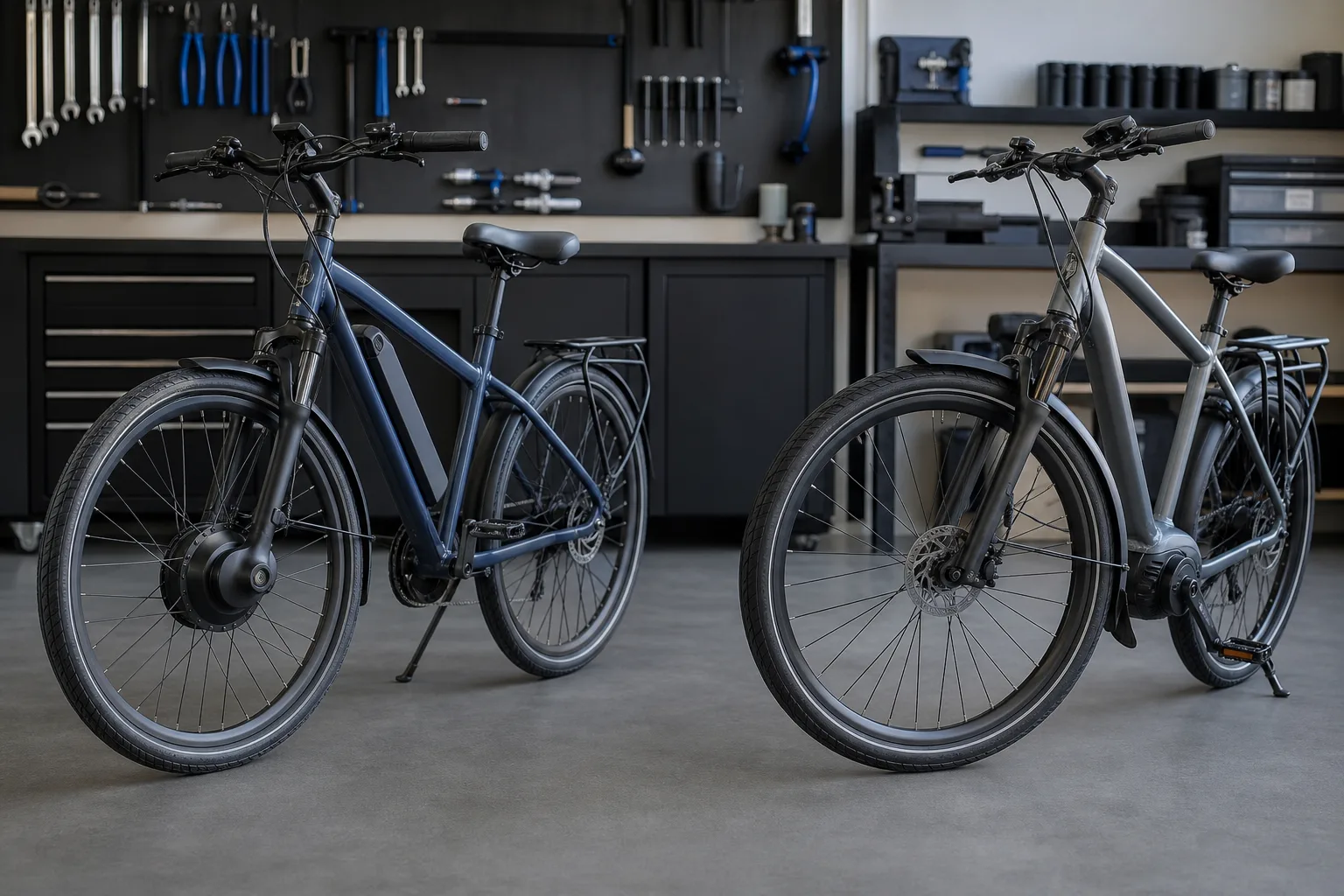
Two bikes with the same battery, the same tires and the same rider will not climb the same grade in the same way, and the reason is almost always where the motor sits and how it is told to help. A careful reader checks three things before anything else: the location of the motor, the sensor that wakes it up, and the numbers printed on the motor casing. Everything else, the display, the paint, the accessory rack, follows from those. The differences are easiest to feel on a hill, because a hill removes the margin that flat ground hides.
Three places to put a motor, three different bikes
A front hub motor pulls the bike from the steering wheel, which is the wheel with the least weight on it and the one you steer with. On dry pavement at moderate power it feels fine, even pleasantly neutral, but on a wet steep start or loose gravel the front tire can slip before it grips, and the fork has to be built to take drive loads it was never originally designed for. The compensation is real: a front motor with a rear-mounted battery spreads mass evenly, keeps the drivetrain entirely conventional, and leaves the rear wheel simple to remove.
A rear hub motor puts the drive under the rider's weight, so traction on a climb is rarely the limiting factor, and the sensation is one of being pushed rather than pulled. The penalty is concentration of mass at the back, which makes the bike heavier to lift onto a rack and slightly lazier to turn quickly at low speed. Crank drives, sometimes called mid-drives, sit at the bottom bracket and put their mass low and centered, which is the best place for it and the reason those bikes handle most like unpowered ones.
Why the crank drive climbs differently
A hub motor is geared once, at the factory, and that ratio never changes. It has one efficient speed range, and a long steep grade that drags you below that range makes the motor draw more current for less output while it heats up. A crank drive feeds its power through the chain and the cassette, so shifting to a lower gear multiplies the motor's torque exactly as it multiplies yours. That is the whole difference on a hill: the crank drive keeps working in its sweet spot as the grade steepens, provided you shift, while the hub motor works progressively further outside its own.
The second-order cost lands on the drivetrain. Everything the motor produces passes through one chain and one cassette, at torque figures no human leg generates, so chains stretch faster, cassettes wear in fewer miles, and shifting under full power will eventually cost a derailleur hanger. Riders who ease off for the half-second of a shift, or who buy a system that cuts power automatically during shifts, see much of that difference disappear. Hub motors leave the chain carrying only leg power, which is why a commuter with a rear hub can go a long time between drivetrain parts.
Flats, and the thing nobody demonstrates in the showroom
Fixing a rear flat on a crank-drive bike is an ordinary bicycle job. Fixing one on a hub-motor bike means supporting the bike, disconnecting or carefully routing a motor cable, dealing with torque washers or an anti-rotation plate, and lifting a wheel that may weigh ten pounds more than you expect. It is entirely doable, and thousands of people do it on the roadside, but it is worth doing once in a garage before it happens in the rain. Tire liners, sealant and a puncture-resistant casing are cheaper than the learning curve.
Sensors and the numbers on the casing
A cadence sensor asks only whether the pedals are turning and then delivers the assist level you selected, which produces a surge at every start and a slightly disconnected feel. A torque sensor measures how hard you are actually pushing and scales the motor to match, so the bike amplifies your effort instead of replacing it, and on a hill that proportionality is what people describe as feeling strong rather than shoved. As for ratings, many bikes reaching American buyers are built on platforms rated 250 watts continuous with assist ending near 25 kilometers per hour, about 15.5 miles per hour, while the domestic class framework recognizes higher limits. The Consumer Product Safety Commission oversees low-speed electric bicycles as consumer products, and the class label on the chainstay tells you which set of rules the bike was built to satisfy.
Ride the same hill on one of each, in the same gear range, and the choice makes itself. What the showroom cannot show you is the four hundredth climb, when the chain, the wheel and the sensor have all had time to state their opinion.