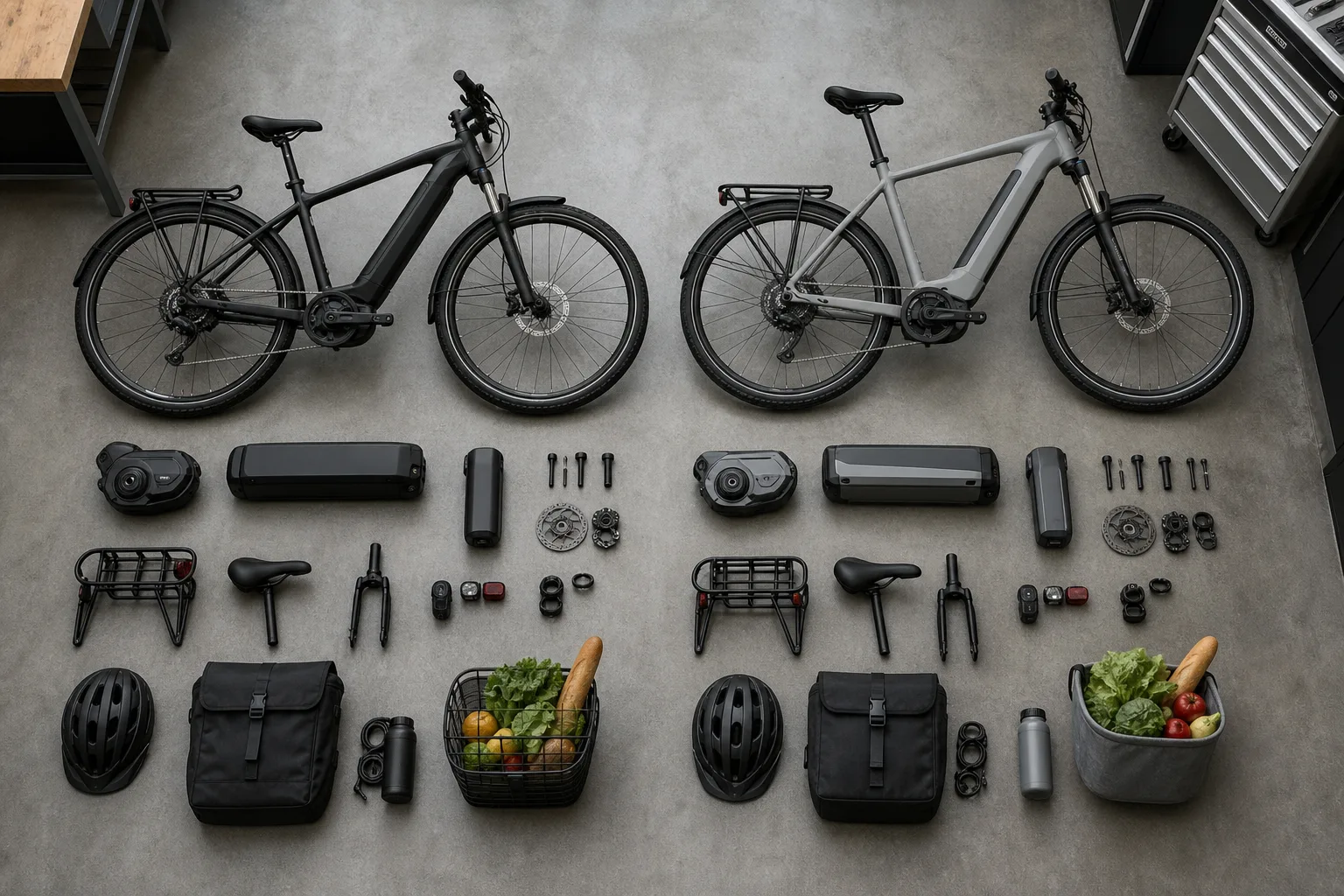
Two bikes sit side by side with the same number on the hang tag, call it fifty miles, and one of them will disappoint you within a week. The tag number comes from a test that suits the manufacturer: a light rider, the lowest assist setting, flat ground, warm air, no cargo, tires at full pressure. Nothing about that is dishonest, but nothing about it resembles a Tuesday with a headwind and two bags of groceries. The number that survives contact with your actual route is the watt-hour figure, and it is usually printed in smaller type.
Watt-hours, not miles, are the unit that compares
Multiply the battery voltage by its amp-hour capacity and you get watt-hours, the size of the tank. A 36-volt, 14-amp-hour pack holds about 504 watt-hours; a 48-volt, 14-amp-hour pack holds roughly 672. That is a third more energy on board, and it is a fact rather than a claim. What varies between bikes is how much of that energy each mile consumes, which on a flat commute with modest assist tends to sit somewhere in the low teens of watt-hours per mile, and on a steep, loaded, high-assist ride can double or better. Divide the tank by the consumption and you have your answer.
This is why two bikes with identical advertised range can differ sharply in practice. A careful reader checks the pack's voltage and amp-hours, notes whether the display can show watt-hours consumed rather than only a battery bar, and asks whether the controller's peak draw is high enough to empty a small pack quickly on climbs. A five-segment battery gauge tells you very little; a trip counter reporting energy used tells you everything, because after two weeks of riding you know your own number and never have to trust a hang tag again.
What the load actually costs
Weight matters most where the road tilts. On flat ground an extra forty pounds of rider and shopping costs a little, mostly in rolling resistance and in the energy spent accelerating away from every light. On a sustained grade it costs a lot, because lifting mass against gravity is the dominant demand and the motor is doing work that no amount of clever gearing removes. A commute with three hundred feet of climbing and a full pannier is a different machine from the same commute empty, and the difference shows up as a battery bar that drops early and then falls off a cliff.
Cold does something separate and easily mistaken for wear. Lithium cells deliver less usable capacity near freezing and their voltage sags under load, so a January ride can read twenty or thirty percent shorter than the same route in June while the pack itself is entirely healthy. It recovers when the battery warms. Assist level compounds all of this: the top setting is not a little more energy than the middle one, it is a different order of consumption, because the motor holds a higher speed against air resistance that climbs steeply with velocity.
Building a worst-case number for your own route
Take the round trip, not the one-way distance, and assume you will not charge at the far end. Add the total climbing from a mapping tool. Assume the loaded return, the cold morning, the tire you forgot to pump, and the assist level you use when you are late rather than the one you use when you are relaxed. Then ride the route once on a full battery, note the watt-hours consumed, and multiply by roughly one and a half. If the pack still has headroom above that figure, the bike fits the commute in every month of the year.
Charging habits and the slow decline
Capacity fades with cycles and with time spent sitting at extremes. Charging to full every night when you only use a third of the pack ages it faster than charging to eighty or ninety percent and topping up as needed, and many chargers or displays now offer a partial-charge setting for exactly that reason. Winter storage wants a cool indoor space, not an unheated garage, and a pack left near half charge rather than full or empty. The Department of Energy oversees battery research and safety standards in the United States, and its guidance on lithium storage points the same direction.
A pack treated this way loses capacity gently, a few percent a year, and the loss arrives as a slightly shorter margin rather than a sudden failure. Buying a battery with headroom over your worst-case number is what makes year four feel like year one.